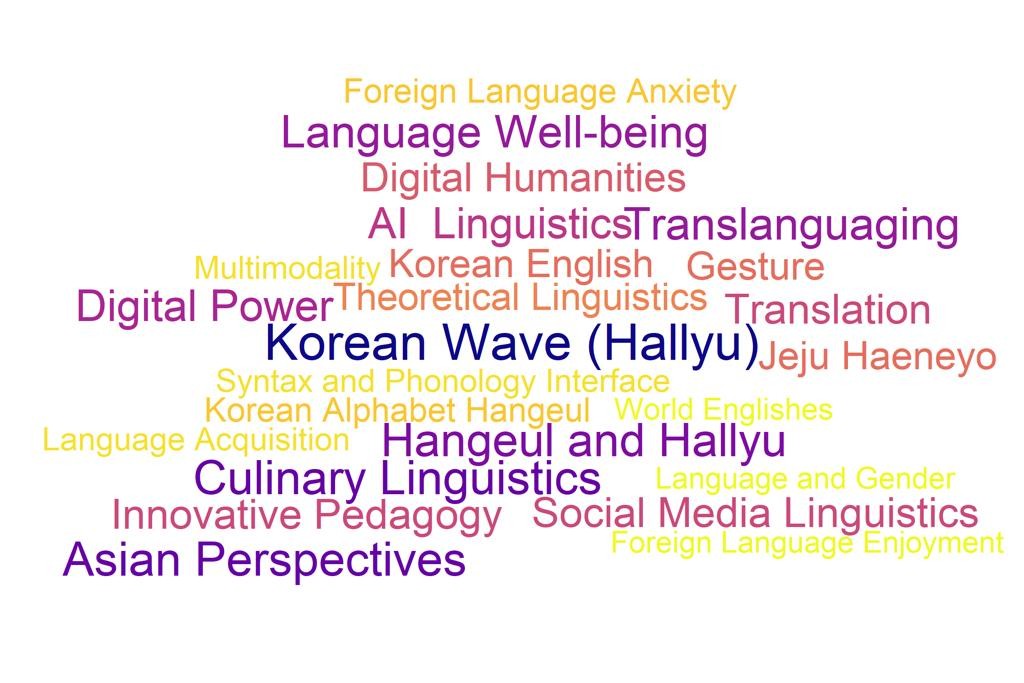
- Hallyu (Korean Wave) Matters
My research on Hallyu covers it’s linguistic and cultural aspects. My initial work began with the language of K-film and K-dramas. Since, it has developed to consider the language of Hallyu fandoms and how fans engage with K-content as both consumers and producers. During the 2000s, Hallyu began globalising with the help of Southeast Asian fans, who engaged with Korean culture in English. This was a precursor to the K-wave’s success on social media, like Twitter. Fuelled by digital developments like smartphones, fans have been able to actively consume and create Hallyu content. Hallyu is the first Asian subculture that has become viral online all over the globe, virtually, assisted by the metaverse. It has the potential to become a model for other subcultures in the future. Currently, I am considering the future of Hallyu, exploring digital Hallyu in an AI age to look at what it means for the future of linguistic and cultural studies.
- Language Learning Matters
I am very interested in bringing innovative technology to the classroom. During the pandemic, we all experienced the need for more effective online learning platforms. Innovative technology can help to increase our children’s enjoyment of language learning by making it dynamic and fun, and also more accessible to all. We live in a multilingual society, but the number of children enrolling in language learning courses is on a steep downturn. This is due to both foreign language anxiety and foreign language boredom, which both further discourage children from learning languages. Reduced uptake has been accompanied by rifts in our society due to a lack of cultural and linguistic understanding. I am researching ways to inspire our children to reengage with language learning. In doing so, I wish to develop methods that are efficient and fun, and thus sustainable. It is not only about the efficacy of learning, the well-being of language learners matters too. It is my hope to build a new language model that can help to build solidarity in our multicultural societies.
- Sound and Gesture Matters
As a theoretical linguist, my work focussed on syntax/prosody interface to show how sound feeds and impacts structural variation diachronically, synchronically, and typologically. Further to sound, I found a repertoire of non-verbal expressions that play a crucial role in making meaning in our communication. I propose that traditional linguistics should be upgraded into multimodal linguistic frameworks, expanding discussion from one dimension to multiple dimensions. In doing so, we will be able to truly engage with living data both online and offline.
- Pragmatic Matters
As a pragmatist, I have always believed that the secret to linguistic variation is pragmatics. This is reaffirmed by the fact that one of the major shortcomings of AI is its lack of pragmatic versatility. Human language is different to that of a machine; there are many complex factors working together at the same time. Although pragmatics may sound abstract, I believe that it is an important area that requires more research. To tackle the challenge of understanding pragmatics, I have proposed the 3 E Model, which asserts that the driving forces behind human language are efficiency, expressivity, and empathy. My research is focused on exploring how language encapsulates these matters, and I am committed to advancing our understanding of pragmatics.
- Future matters: AI Linguistics
Over the last decade, and particularly since the pandemic, our lives have migrated into online spaces. We now live in a digital world and so there are implications for our language. I have noticed that there is a great speed discrepancy between online and offline worlds. An increasing amount of human interaction is being mediated by digital devices, and it’s shocking to see how much this has changed over the course of the last 20 years. Now developments in deep learning and artificial intelligence may mean that an AI tsunami is upon us. I am proactively engaging with the issue of AI in my research. I invite linguists, policymakers, and people of all generations to seriously think about the implications of AI.
- Asian Perspective: Translation, Commentary and Multilingualism
I believe that every language and its speakers matter. In 20th century discourse, the voices of Asian people were largely marginalised, untranslated, and unnoticed. Even now in the UK, some of the largest diaspora populations are of Asian background, but little attention has been paid to non-European language and culture, which are excluded from school curriculums. Modern languages in the UK includes Western languages plus Mandarin. For the sake of equality and diversity, this has to change. Scholarship is not just about increasing the quantity of materials, but it is also about bringing fair perspectives to our literature, culture, and beyond. As the Series Editor for Routledge Studies in East Asian Translation, I aim to lessen the translational imbalance between the Anglophone world and that of East Asia. I have published translation and commentary on Middle Korean poetry and Jejuan, a variety of Korean spoken in Jeju. I draw attention to certain languages/dialects that have so far received limited attention. I feel that it is important to raise awareness for Asian languages to bring the right respect to its literary and cultural heritage. I am working on two commentaries to shed more light and bring a balanced view to this important issue.
- Words Matter
The words that we use and live with every day are a reflection of who we are. In our increasingly diverse world, words live across the boundaries of nation state borders and languages. Encoded within them is the reality of our lives. Our words’ evolution represents us. Through researching our words and their developments, we can better understand our societies and their phases of metamorphosis. My research focusses on foreign words, subcultural words, and hybrid words in the English language, which were once labelled “alien and denizens” (James Murray). I look at the transformative power of them on the English lexicon.
- Food Matters: Culinary Linguistics
As a necessity for our survival, discourse surrounding food has existed throughout human history, providing great insights into the emotional and cultural elements of human communication. There is so much expressivity within food talk that it has the power to build solidarity between us. As such, I am particularly interested in this topic, and I would like to develop it as a field of study.

 Jieun Kiaer | 조지은 | 趙知恩